


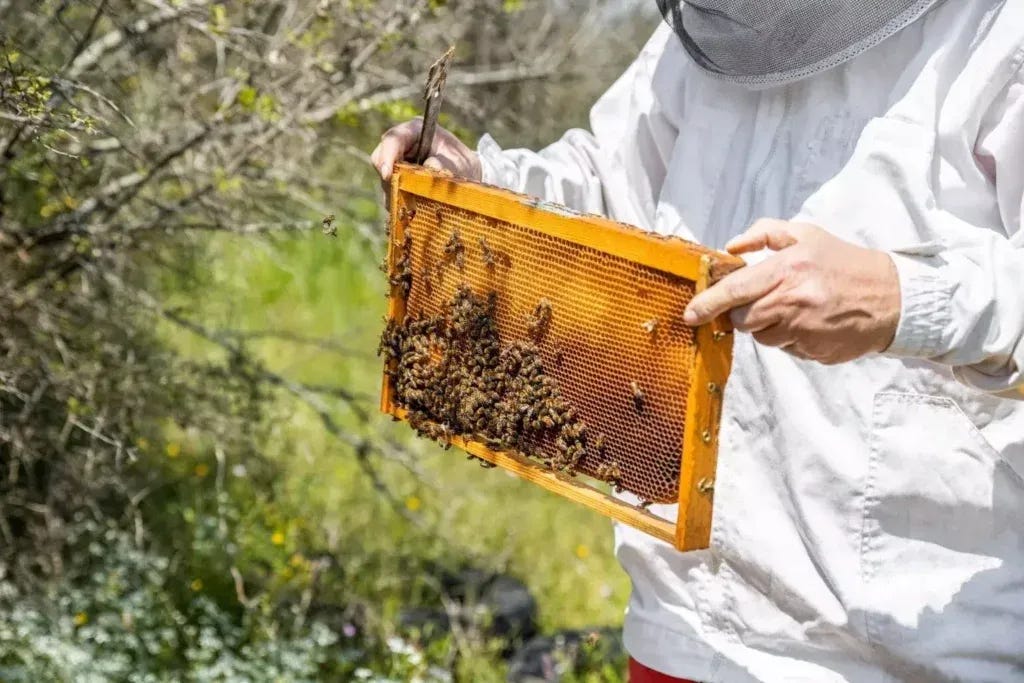
Every Greek beekeeper keeps two calendars: one for humans and one for bees.
The human version hangs in the kitchen, with feast days circled in red. The other is invisible — written in pollen, weather, and instinct. When the first almond trees bloom, the hives wake. When the heather dies, it’s time to move on.
Bees live by their own chronology, and the people who follow them must learn to read it. “Some people need calendars to tell them what month it is. Since I took up beekeeping, I’ve lost that habit,” says Christos Skarlatos, my friend and a beekeeper who cares for over 100 hives in the hills around Athens. “I just watch and listen to my bees. They show me whether it’s April or October.”
January–February: Sleeping with one eye open
In winter, the hives hum like sleeping animals. The queen stops laying eggs; workers cluster around her for warmth, vibrating their wings to keep the temperature near 34°C. “Disturbing a hive at this time is a death sentence to the bees,” Christos says. “Put simply, they will die.”
Beekeepers spend these months mending equipment, painting boxes, melting wax. They walk to the hives just to listen — a low, collective heartbeat under snow. “If you hear a gentle hum, you know the hive is healthy. If it’s silent, that’s when you know something awful has happened.”
March: The almond moon
Spring begins with the almonds. Pale pink blossoms appear like smoke on the hillsides. Bees pour out, ravenous, their first forage after months of fasting. Nectar becomes brood food; the queen resumes laying.
Christos checks each hive for strength. Weak colonies are merged; strong ones split into “nucs,” nucleus hives that will form new colonies. “Spring is like Easter for bees. It’s when they start multiplying” he says.
Did You Know?
Bee heat: A winter cluster of 10,000 bees can generate the same warmth as a 60-watt bulb.
Almond bloom: Greek almonds flower two to three weeks earlier than in Spain, giving native bees a head start.
Lifespan math: A winter bee lives up to 120 days; a summer worker lasts only 40, exhaustion by design.
Hive census: Greece hosts over 1.5 million beehives, the highest density per capita in Europe.
April–May: The thyme promise
By late spring, the landscape explodes: thyme, sage, wild oregano, citrus groves. The bees gorge, the hives swell, and the beekeepers barely sleep. “This is when you’re so busy. I get little sleep and sometimes forget to sleep,” Christos laughs. “It’s just fields, hives, flowers, and the occasional sting.”
He moves his hives weekly (sometimes to the hills, sometimes down onto the flatter ground in among the olive trees; always chasing blossom waves. In the old days, this migration was done on donkeys; now it’s his pickup truck at midnight. “We move the bees at night, in the dark.” he explains. “It disturbs them far less.”
At each new site, he lights a little smoke and whispers and welcomes them to their latest neighbourhood.
June: The harvest of light
June is the first extraction. Frames heavy with honey are lifted, brushed, and spun in gleaming centrifuges. The air smells of warm wax and sugar. It’s the beekeeper’s Christmas — except it’s 40°C and you’re wearing a veil.
Honey drips from the spinner like slow amber rain. Christos tastes with his fingertip: thyme this year, and a little sage. “Every harvest represents a different and unique fingerprint,” he says.
After bottling, he leaves a third for the bees – their food for the coming weeks; one they worked hard for.
Did You Know? (Part II)
Nocturnal travel: Bees orient by sunlight, so moving hives after dusk prevents them returning to the old site.
Honey code: Early summer honeys are lighter and floral; autumn ones darker, resinous, and mineral-rich.
Travel radius: Foraging bees cover up to 5 km a day, equivalent to a human walking from London to Brighton and back.
Queen politics: Greek beekeepers often raise new queens from the mild-tempered Apis mellifera adami, native to Crete.
July–August: Heat and hazard
By midsummer, the bees slow down. The sun bakes the flowers, nectar dries up, and the air smells of dust and pine. Drought is the new enemy.
In recent years, Christos has begun hauling water to his hives. “This is new. My father’s generation never did this,” he says. “Now, summers are drier. There’s less rain, less water.”
Wildfires add another threat. In 2021, a blaze near Gythio destroyed hundreds of hives. Some beekeepers rebuilt; others left the trade. On the hottest summer afternoons, Chrisos props open the hive lids to vent heat. Inside, bees fan their wings in perfect synchrony - a tiny chorus of resilience.
September: The pine migration
When the lowlands wither, the beekeepers drive north to pine forests (Chalkidiki, Evia, Thassos) where sap-feeding insects called Marchalina hellenica excrete sweet honeydew. Bees collect it greedily, producing thick, amber pine honey.
At night, trucks line the forest tracks like an army of glowing eyes. Generators hum. Beekeepers drink coffee and talk quietly about weather and politics. “Beekeepers have their own hives and are protective of their bees,” Christos says. “But we’re also good at sharing information and resources. It’s not a zero-sum game where, if one beekeeper wins, the other loses. We all share the same flora and what they offer. And we share the same luck that the weather offers – good or bad.”
October–November: Winding down
Autumn brings chestnut and heather blooms. The bees feed heavily to build winter fat. Queens lay their last eggs before the brood break. Beekeepers clean, treat for mites, and prepare to lock down for cold months.
Some years, there’s a late bloom and a surprise second harvest. “We don’t count on it,” Christos says. “If nature intends for us to have a second season of honey, then that’s great. But it’s always treated as a bonus.”
December: Silence again, and then the cycle starts again
The hives go quiet. Snow falls on the lids like a blanket. Inside, 20,000 bees cluster in warmth, dreaming of spring. Christos stores his in the cellar - row upon row, each labelled by flower and year. Some will go to markets, some to neighbours, a few to strangers who him on his Agale Instagram page.
Come January, he’ll listen again for that low hum of life inside the box. If it’s there, he’ll smile and mark the new season’s first entry in her bee-calendar: They made it.
For now, he sips tea sweetened with last year’s heather honey. He lights a candle in his local chapel on St Charalambos Day (the patron saint of beekeepers). The bees are resting. The mountains sleep. And the rhythm of wings, invisible but eternal, keeps time with their heartbeat.
Sources