


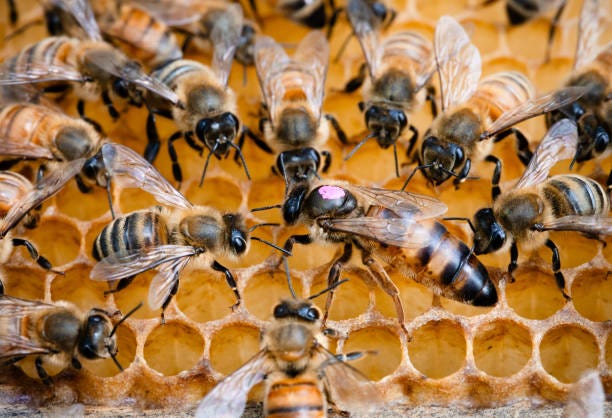
Every Greek beekeeper knows her: a single insect at the centre of the storm. Long-bodied, slow, and constantly attended, the queen bee rules not by command but by chemistry. She never raises her voice — she emits it.
To watch her move through the hive is to witness politics in miniature: one monarch, thousands of workers, no rebellion — just purpose. “Despite the chaos and non-stop work of her children around her, she’s always remains calm,” says Christos Skarlatos, my friend the beekeeper from Athens.
Birth of a monarch
The queen’s story begins as an act of divine engineering. All bee eggs are identical, but a few are chosen for greatness. The difference? Diet. Royal larvae are fed royal jelly - a nutrient-rich secretion that triggers full fertility and a longer life. In mythic terms, it’s ambrosia.
After 16 days, a new queen emerges. If rivals hatch, she kills them - a ritual the ancients would have recognised and approved of by them. In Greek myth, succession always comes drenched in blood.
Once she’s crowned, she takes her nuptial flight: a dizzying dance in the sky where she mates with up to 20 drones, storing their sperm for life. Then she returns to the hive, never to fly again. From then on, her body becomes an engine of creation — 2,000 eggs a day, one every 43 seconds.
Did You Know?
Royal diet: Royal jelly contains a protein called royalactin, which alters the queen’s DNA expression, switching on genes for fertility and longevity.
Longevity gap: A queen lives up to five years; workers last about six weeks.
Mating altitude: Queens fly as high as 20 metres during nuptial flights — out of reach of predators.
Sperm bank: One queen’s spermatheca can store up to 7 million sperm cells, fertilising eggs for her entire reign.
The hive’s invisible government
Every hive is a parliament of scent. The queen releases pheromones that regulate behaviour - suppressing rival queens, coordinating workers, even signalling the colony’s emotional state.
“The hive remains calm and there is order in the world of the bees if their queen is calm,” Christos says. “But if she’s flies or does, you can see and hear the manic instability in the way the rest of the hive behaviours.”
Workers fan her scent through the hive like incense in a church. It’s devotion by diffusion. They feed her, clean her, and surround her constantly - a living crown. Yet the queen herself does nothing but lay eggs. She doesn’t command; she simply is.
To outsiders, it looks tyrannical. To beekeepers, it’s balance. “When you have tens of thousands of individual bees, chaos would rain if there the instinctive hierarchy of the hive’s monarchy was any but,” Christos smiles. “Bee society could never be ‘democratic’.”
The mythic mirror
The Greeks saw bees as sacred long before science explained them. Priestesses of Demeter and Artemis were called Melissae (“the bees”) guardians of fertility and order. The queen bee, in their eyes, was divine principle made visible: female power rooted in service, not domination.
The poet Pindar wrote of “honeyed voices” as blessings of the gods. Aristotle dissected hives and called the queen “the mother of all.” Centuries later, monastic beekeepers in Mount Athos still refer to her as Basilissa, the royal lady. When Christos points to his queen, he sometimes bows half-jokingly. She rules him as much as she does the thousands of others in her hive.
Did You Know? (Part II)
Ancient worship: Clay hives from Knossos (c. 1500 BC) depict a central female bee figure - the earliest known symbol of matriarchal divinity.
Word roots: Melissa means “honeybee” and was once a common priestess title in Greece.
Honey politics: The term “queen bee” appears in Greek texts centuries before English adopted it.
Social castes: A typical hive has one queen, hundreds of drones (males), and 20,000–50,000 female workers - all sterile sisters.
The sisters’ burden
The workers (all female) are the unsung heroes. They clean, feed larvae, tend the queen, guard the hive, and forage. Each task matches her age: nurses at two weeks, foragers at four, dead by six.
“They literally work themselves, for weeks of their short life, to a heroic death,” Christos says, watching a returning forager collapse at the hive entrance. “Look at that one,” he points to one of the bees buzzing slowly at the edge of the hive’s lid. “She’s exhausted. You can just about see how shredded her wings are. Give it a few hours, and she will do maybe one more run to the fields, collect her last load, and then, having delivered it, she will just fall out of the sky, dead.”
It sounds bleak but it also feels apt, reflecting the kind of Greek tragedies with heroes who give their all for the good of their city or community.
Inside, the air hums with cooperation so precise it feels choreographed. Bees pass nectar mouth to mouth, fan air to thicken it into honey, and line the comb with wax secreted from their own bodies. It’s exhausting and eerily selfless. When a beekeeper opens a hive, that hum swells - half alarm, half symphony.
In modern metaphor, “queen bee” often means an overbearing boss. In real hives, she’s simply the reproductive core. The real lesson, Christos argues, isn’t hierarchy but harmony. “Everyone plays their co-dependent part. Even the queen is not self-sufficient. If her daughters stopped feeding her, she would die.”
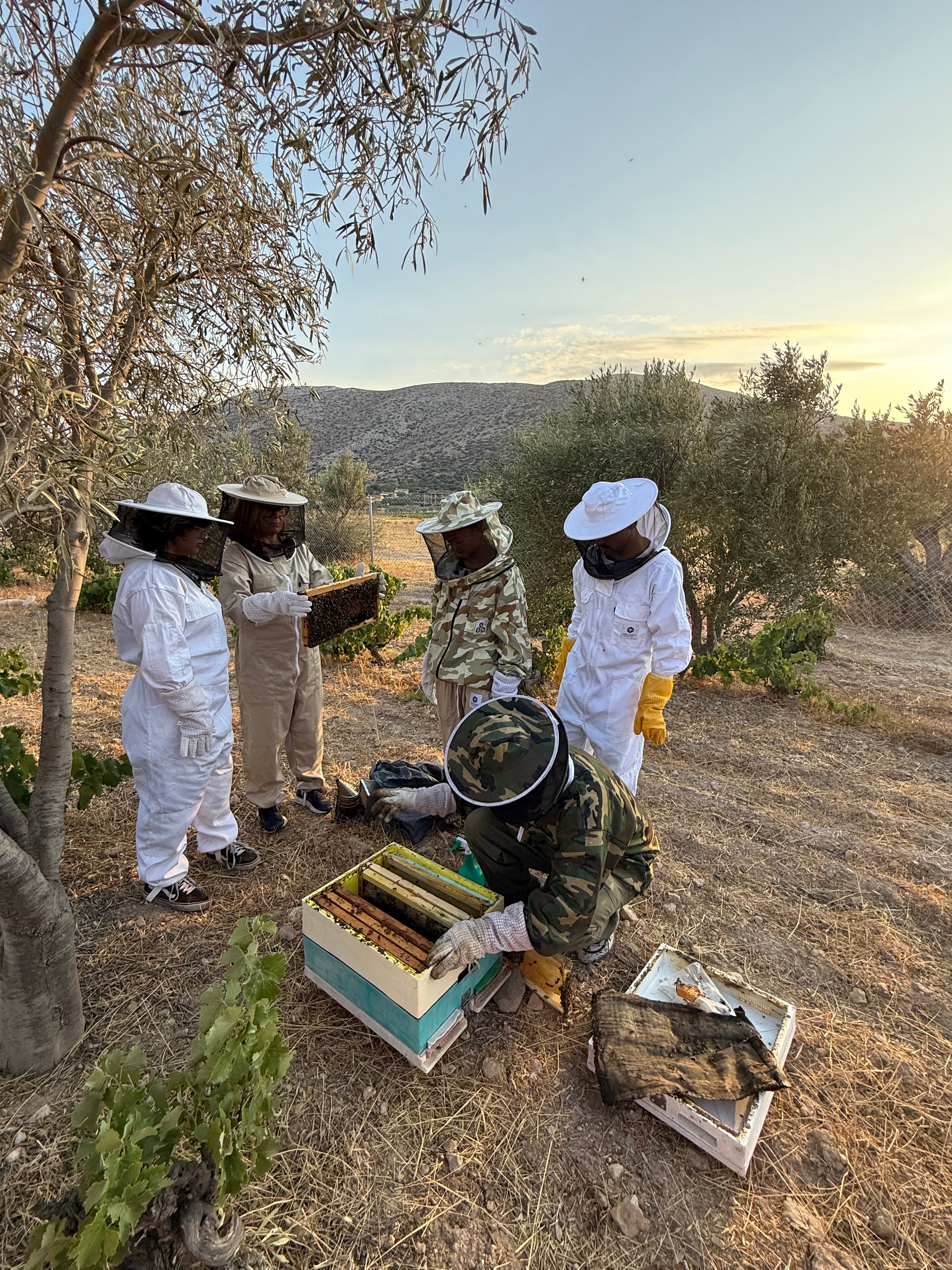
The hive collapses if balance breaks - through pesticides, parasites, or stress. “You cooperate with the queen and her colony… they work together, and you work with and, to some extent, for them.” That’s the beekeeper’s secret creed: you don’t own bees; you accompany them.
The scent of continuity
Each spring, when a colony becomes too crowded, the old queen leaves with half the hive to form a new one - a swarm. The sight is biblical: a moving cloud of gold and sound. Christos watches them rise like smoke, then drift toward an olive tree.
He waits until they settle, then gently shakes them into a wooden box. “She’s there,” he whispers, listening for the distinct hum. “The song changes when the queen is safe.” Within hours, the swarm has rebuilt order – wax and brood.
To the ancients, the hive was a model for civilisation: disciplined, selfless, ruled by a hidden wisdom. Plato compared ideal society to bees; Virgil called them “a little world of heaven.”
In Greek monasteries today, monks still quote Psalm 118 while tending hives: ‘Sweeter also than honey and the honeycomb.’ The bees, they say, teach humility - service without ego. Christos agrees.
“Every year I open the hive and am constantly in awe of what these creatures do, how they organise themselves. And, obviously, the positive impact they have on the environment around them.”
At dusk, the hive settles. The queen moves slowly through her chamber, laying eggs into perfect hexagons. Around her, thousands of sisters hum their lullaby of purpose. Outside, the beekeeper closes the lid, hands sticky with wax. In that moment, the myth feels literal - a living echo of all the old Greek goddesses who ruled without crowns, through patience, rhythm, and scent. The queen is not a symbol of power. She is proof that real authority hums quietly - surrounded by the infinite whisper of wings.
Sources